Qelvanto
Arc Collection
Arc Collection
Couldn't load pickup availability
-
Problem Statement
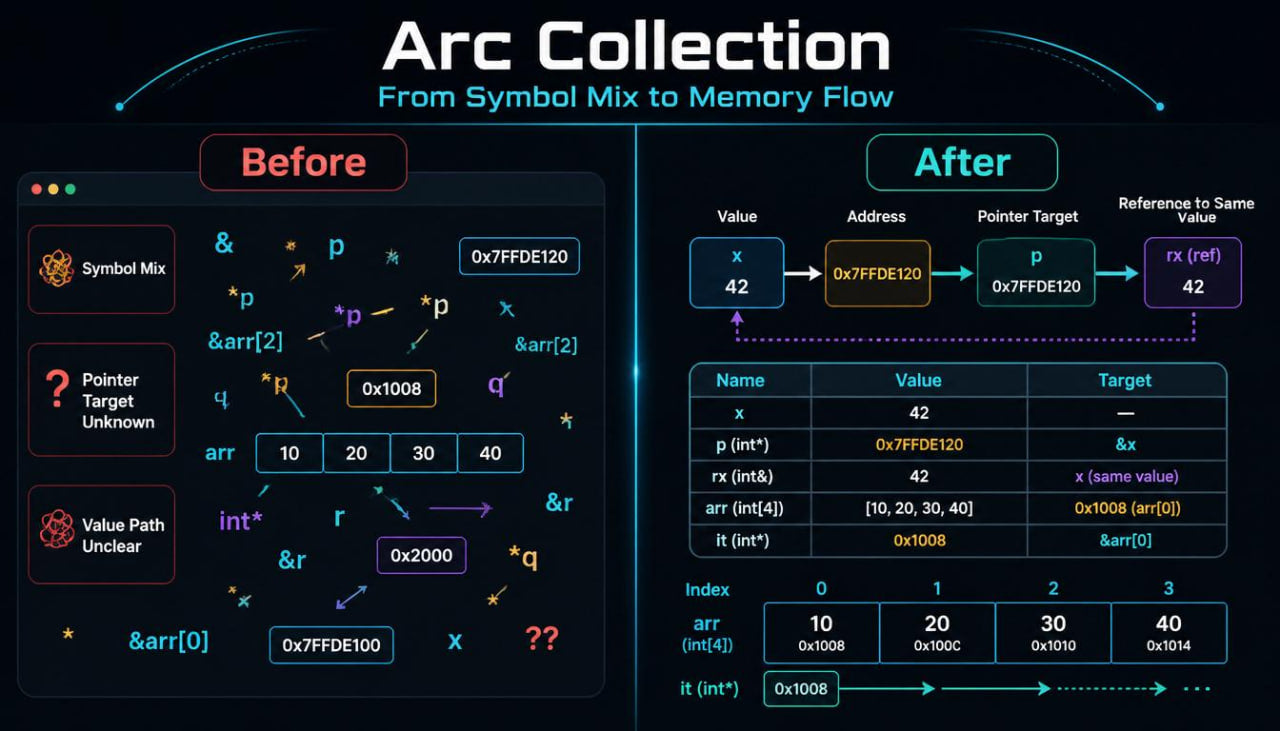
After learners study classes, objects, functions, arrays, strings, and class relationships, C++ introduces topics that require close attention to how values are stored and reached. Pointers and references can feel unusual because they ask the learner to think beyond the visible value and consider where that value is located or how another name connects to it. A learner may understand variables in simple examples, yet feel unsure when address symbols, dereferencing, reference parameters, and dynamic allocation appear in the same file. Memory-related code can also be difficult to read when examples skip the reasoning behind each symbol. Arc Collection was created for learners who want a calm written path through pointers, references, and related C++ structures. -
Solution
Arc Collection explains pointers and references through organized modules, annotated examples, tracing tables, and review tasks. The course begins with the idea of value storage, then moves into addresses, pointer variables, dereferencing, references, function parameters, arrays with pointers, and dynamic allocation basics. Each topic is introduced with compact code samples and plain wording, so learners can read one idea before moving into the next. Practice sections ask learners to trace values, identify what a pointer holds, explain what a reference changes, and compare similar examples. The materials connect memory-related topics with earlier Qelvanto courses, especially variables, functions, arrays, and object-based code. -
What’s Inside
Arc Collection begins with an orientation section about how to read memory-related C++ code. The course explains that some code works directly with values, while other code works with the place where a value is stored. Learners are guided to separate three ideas: the variable name, the value inside the variable, and the address connected to that variable. This opening section gives learners a reading routine for later modules: identify the original value, find the pointer or reference, follow the symbol, then describe what changes.
The first module introduces addresses. Learners review short examples where a variable is created and its address is shown through the address-of symbol. The course explains the idea in plain language and avoids long technical theory at the start. The learner studies how an address is not the same as the value itself, even though both are connected to the same variable. Practice prompts ask learners to label the variable, value, and address expression in short code lines.
The next module introduces pointer variables. Learners study how a pointer can hold an address. The course explains pointer declaration, pointer assignment, and the difference between the pointer variable and the value it points toward. Each example is shown with a small table that separates variable name, stored value, address, and pointer relation. This helps learners avoid mixing the pointer itself with the value reached through it.
A dedicated dereferencing section follows. Learners review how the dereference symbol can be used to reach the value connected to a pointer. The course uses compact examples where a value is read, changed, or printed through a pointer. The notes explain how to read the line slowly: pointer name first, dereference symbol second, reached value third. Practice tasks ask learners to predict what changes after a dereferenced assignment and to explain the final value in plain language.
Arc Collection then introduces null pointer basics. The material explains how a pointer may intentionally point to no object or value at a given moment. Learners read examples where a pointer is checked before use. The section focuses on safe reading habits: notice whether the pointer has a valid target, look for a condition, and explain why the check appears before dereferencing. The course does not use fear-based wording; it simply shows why careful pointer review matters.
The next module focuses on references. Learners study references as another name connected to an existing value. The course compares a direct variable change, a pointer-based change, and a reference-based change. This comparison helps learners see how the same value may be reached in different ways. Practice tasks ask learners to identify which name belongs to the original variable and which name works as the reference.
A reference parameter section connects this topic with functions. Learners review examples where a function receives a value by reference and changes the original variable. The course compares pass-by-value and pass-by-reference examples side by side. Learners are asked to trace what happens before the function call, inside the function body, and after the function finishes. This section is especially useful for understanding why a function can change a value outside its own block.
Arc Collection also includes pointer parameters. Learners study compact examples where a pointer is passed into a function and used to reach or change a value. The course explains the relationship between the argument, parameter, address, and dereferenced value. Practice prompts ask learners to mark which line sends the address, which line receives it, and which line changes the reached value.
The course then moves into arrays and pointers. Learners review how array names and pointer-like behavior can appear together in C++ examples. The material is careful and gradual, beginning with a small array and a pointer that moves through values by position. The section explains how index reading and pointer movement are related but not identical in how they appear on the page. Learners complete tasks that ask them to follow array values, pointer positions, and loop steps.
A dynamic allocation basics module follows. Learners study the idea that some values can be created during program work and later released when no longer needed. The course introduces allocation and release syntax through short examples with detailed notes. The focus stays on reading and responsibility: identify where the value is created, where it is used, and where the code releases it. The examples remain compact, so learners can study the structure without being overwhelmed.
Arc Collection includes a memory review workbook. This workbook presents short code examples with variables, pointers, references, functions, arrays, and dynamic allocation basics. Learners trace values, mark pointer targets, explain reference behavior, and identify where changes happen. Some tasks ask learners to compare two similar snippets and describe how one symbol changes the result.
A glossary section explains terms such as address, pointer, dereference, reference, null pointer, reference parameter, pointer parameter, dynamic allocation, release, target value, and memory relation. Each term is paired with a compact C++ example.
The final review set combines several ideas from the course. Learners read a short file with variables, functions, pointer parameters, reference parameters, array review, and dynamic allocation notes. They answer guided questions about what each name stores, what each pointer reaches, what each reference changes, and how values move through the code.
-
Who Is This For?
Arc Collection is for learners who already understand variables, functions, arrays, strings, classes, and object relationships. It is intended for learners who are ready to study pointers, references, and memory-related C++ concepts through structured written materials.
This tier may fit learners who have seen pointer syntax before but still find it hard to explain what each symbol does. It is also useful for learners who want more practice tracing how values are reached, changed, and passed through functions.
Arc Collection is written for people who prefer annotated examples, short modules, review tables, glossary notes, and guided practice. The course focuses on careful reading and practical study habits without job claims, financial claims, or fixed outcome statements.
- What You’ll Learn
- How to separate a variable name, value, and address
- How pointer variables store addresses
- How dereferencing reaches a value through a pointer
- How null pointer checks appear in simple examples
- How references connect another name to an existing value
- How reference parameters can change original values
- How pointer parameters work inside functions
- How arrays and pointers can appear together
- How to trace pointer movement through array values
- How dynamic allocation basics are written and reviewed
- How to identify where created data is released
- How to explain memory-related code in clear written notes
-
Refund Note
Arc Collection is a paid Qelvanto tier. Eligible course purchases may be reviewed within a 30-day refund window according to the refund terms shown on the store page.
Self-paced learning overview
- 📘 Digital file available after purchase
- 🗂️ Long-term availability
- 🔐 Secure checkout
- 🗓️ Content updated in 2026
What format are Qelvanto courses provided in?
What format are Qelvanto courses provided in?
Qelvanto courses are provided as digital written materials with organized modules, examples, practice tasks, recap sections, and review notes. The focus is on reading, code observation, written exercises, and steady topic review.
Do I need previous C++ knowledge before starting?
Do I need previous C++ knowledge before starting?
Some Qelvanto tiers begin with beginner-friendly explanations, while wider tiers include more detailed C++ topics. Each course page explains the intended study stage, so learners can choose materials that match their current background.
Can I study at my own pace?
Can I study at my own pace?
Yes. The materials are arranged in sections, so learners can read, pause, return to earlier pages, and repeat practice tasks when needed.
Share