Qelvanto
Drift Framework
Drift Framework
Couldn't load pickup availability
-
Problem Statement
After learners study conditions, loops, and basic functions, C++ begins to introduce data in grouped forms. A single value is usually simple to follow, but a row of values can feel more difficult because every item has a position, a type, and a relationship to the surrounding code. Arrays may look compact, yet learners often feel unsure about indexes, size, loop-based reading, and value changes inside repeated actions. Strings can also create confusion because they appear friendly on the surface, while still following strict rules in code. Drift Framework was created for learners who want a guided way to study grouped data, string handling, and repeated review examples. -
Solution
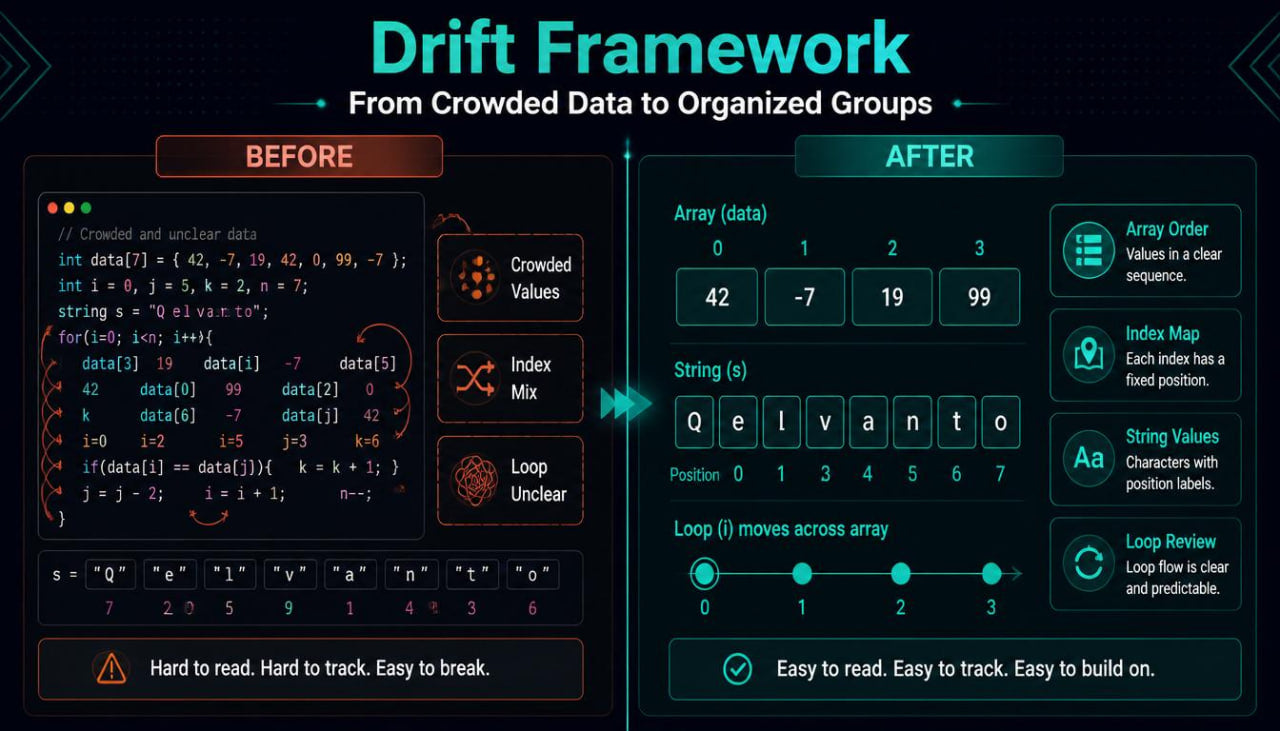
Drift Framework explains grouped data through a structured written path that begins with small arrays and moves toward practical reading tasks. The course shows how values can be stored together, how indexes point to positions, and how loops can move through a group one item at a time. String examples are introduced with careful notes, so learners can observe characters, length, comparison, and simple text operations. Each topic includes annotated examples, written practice, tracing tables, and recap pages. The materials help learners connect previous C++ topics with a more organized view of grouped information. -
What’s Inside
Drift Framework begins with a study guide that explains how to approach grouped data. Learners are invited to read examples slowly, mark the starting index, follow each loop round, and write down how values change. This opening section connects earlier topics with the new material: variables hold one value, while arrays and strings let learners work with a group of related values.
The first module introduces arrays as ordered groups. It explains how an array is declared, how its size is written, and how values are placed inside braces. The notes show small examples with number arrays, character arrays, and simple lists of values. Learners review the difference between the array name, the position of an item, and the value stored at that position. This section includes short reading prompts that ask learners to identify the first item, the final item, and the position of a selected value.
The next module focuses on indexes. Since C++ arrays begin counting from zero, many learners need repeated practice with position-based reading. Drift Framework includes index maps, small diagrams, and table-style notes that show how each value has a numbered place. Learners answer tasks such as: Which value is at index 2? Which index holds a given value? What happens when a loop starts at zero and stops before the size value? These questions help learners slow down and connect the number in brackets with the item being selected.
A separate section explains arrays and loops together. Learners study how a loop can visit each item in an array and perform the same action across the group. Examples include printing all values, finding a total, counting selected items, and changing values through repeated steps. Each example is broken into starting value, loop condition, index use, repeated statement, and final result. Practice tasks include tracing tables where learners record the index and value during each loop round.
Drift Framework also includes a module on common array reading mistakes. This section discusses unclear size values, mismatched loop conditions, forgotten updates, and attempts to read outside the intended range. The wording stays calm and practical, focusing on how to notice the issue in written code. Learners compare two similar snippets and explain which line changes the behavior. This builds careful reading habits without relying on dramatic claims.
The next part introduces strings. The course explains strings as text-like data that can be stored, compared, measured, and used inside code. Learners review how strings differ from single characters and how a text value can be assigned to a name. The examples include simple names, labels, messages, and short input-style cases. The course does not depend on outside tools or named software; it keeps attention on the C++ material itself.
A string length section follows. Learners study how length can be used in conditions, loops, and review tasks. Examples show how a string can be checked for length, how empty text differs from text with characters, and how length can guide a loop. The course also shows how characters inside a string can be observed by position. This connects string study back to index thinking, giving learners a bridge between arrays and text handling.
Another module introduces simple string comparison and selection. Learners read examples where values are compared, labels are checked, and conditions respond to selected text. The tasks ask learners to explain what is being compared and which branch would run for a given value. This section brings together strings, conditions, and code reading.
Drift Framework includes a function practice section connected to arrays and strings. Learners study small functions that receive values, return results, or help organize repeated work. Examples may include a function that checks a number group, counts matching items, or returns a simple text result. The course explains parameter reading, function calls, and return values through short code blocks. Learners are asked to identify what enters the function, what happens inside, and what value comes back.
The course also contains a combined practice workbook. This workbook uses short C++ examples that include arrays, loops, strings, and functions. Learners trace the code step by step, complete missing lines, label array positions, and explain the final result in plain language. The workbook is designed for repeated review, so learners can return to the same task later and compare their notes.
A glossary section explains terms such as array, index, size, element, loop counter, string, character, length, comparison, parameter, and return value. Each term is paired with a compact code reference. The glossary works as a companion while reading the modules.
The final review set combines several skills from the course. Learners may read an array, loop through its values, use a condition inside the loop, compare a string, and call a small function. The review is written to show how grouped data connects with topics from earlier Qelvanto tiers.
-
Who Is This For?
Drift Framework is for learners who already understand variables, conditions, loops, and simple functions, and now want to study grouped data in C++. It is suitable for learners who feel ready to move from single values into arrays, strings, and index-based examples.
This tier may also fit learners who have seen arrays before but still find loop-based array reading confusing. The course provides diagrams, tables, annotated examples, and written prompts that make each step easier to follow without using the restricted wording from the Qelvanto style rules.
Drift Framework is also useful for learners preparing to study larger C++ structures later. Arrays and strings appear in many C++ topics, so this tier gives learners practice with reading grouped information, tracing value changes, and connecting several ideas inside one code sample.
- What You’ll Learn
- How arrays store related values in order
- How indexes point to positions inside an array
- How array size affects loop structure
- How to trace a loop that moves through array values
- How to identify and explain value changes inside repeated code
- How strings store and organize text-like data
- How string length can be used in conditions and loops
- How characters can be observed by position
- How simple string comparison works in examples
- How functions can organize array and string tasks
- How to read combined examples with arrays, loops, strings, and functions
- How to use tracing tables for grouped data review
-
Refund Note
Drift Framework is a paid Qelvanto tier. Eligible course purchases may be reviewed within a 30-day refund window according to the refund terms shown on the store page.
Self-paced learning overview
- 📘 Digital file available after purchase
- 🗂️ Long-term availability
- 🔐 Secure checkout
- 🗓️ Content updated in 2026
What format are Qelvanto courses provided in?
What format are Qelvanto courses provided in?
Qelvanto courses are provided as digital written materials with organized modules, examples, practice tasks, recap sections, and review notes. The focus is on reading, code observation, written exercises, and steady topic review.
Do I need previous C++ knowledge before starting?
Do I need previous C++ knowledge before starting?
Some Qelvanto tiers begin with beginner-friendly explanations, while wider tiers include more detailed C++ topics. Each course page explains the intended study stage, so learners can choose materials that match their current background.
Can I study at my own pace?
Can I study at my own pace?
Yes. The materials are arranged in sections, so learners can read, pause, return to earlier pages, and repeat practice tasks when needed.
Share