Qelvanto
Luma Pattern
Luma Pattern
Couldn't load pickup availability
-
Problem Statement
Many learners begin C++ by copying code examples without fully understanding why each line is written in that exact form. A beginner may recognize symbols such as braces, semicolons, names, and values, yet still feel unsure about how these parts work together inside a complete example. Early study can also feel uneven when one topic is explained in detail while the next topic appears without enough preparation. Learners often need more than a short sample because C++ has strict structure, and small mistakes can change how a program behaves. Luma Pattern was created for learners who want a more complete early study course with steady explanations and practical review tasks. -
Solution
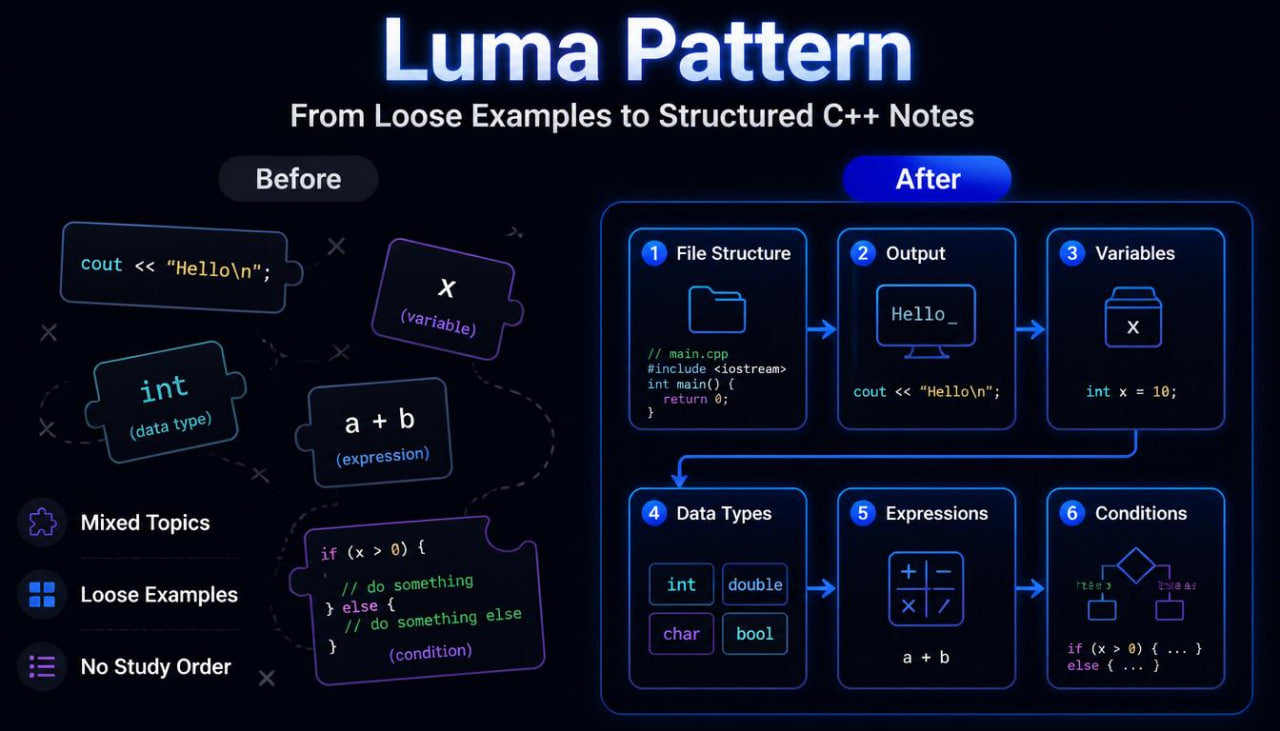
Luma Pattern gives learners a structured path through the first layer of C++ topics using written modules, code examples, and guided exercises. The course takes simple ideas such as output, variables, data types, expressions, and conditions, then arranges them into a readable study sequence. Each topic is introduced with a short explanation, followed by examples that show how the idea appears in code. Practice tasks ask learners to identify, rewrite, compare, and explain small code sections in their own words. The course helps learners build a clearer relationship between C++ syntax and the meaning behind each instruction. -
What’s Inside
Luma Pattern begins with a course orientation that explains how to move through the materials. The learner is encouraged to read each module in order, pause after code examples, complete the written tasks, and return to recap pages when a topic needs review. This creates a calm rhythm for study and makes the course suitable for learners who prefer a guided written format.
The first module introduces the shape of a basic C++ file. It explains how code is arranged, why symbols must be placed carefully, and how a simple example can be read from the first line to the final statement. The module includes annotated code blocks where each part is described in plain language. Instead of showing code alone, the material explains what the learner should notice: structure, order, names, values, and repeated patterns.
The next module focuses on output and text display. Learners review how simple output statements are written and how text can be placed inside a program. The section includes examples with short messages, number values, and combined output lines. Practice tasks ask learners to compare similar examples, find the changed part, and describe what the output would show. This helps learners connect written code with visible results.
A separate section introduces variables and values. This part explains how a name can hold information, how a value can be placed into a variable, and how that value can be used again later. The module includes examples with whole numbers, decimal values, characters, and text. Learners are asked to identify the type of value, the variable name, and the role of assignment. The section also includes small correction tasks where learners review lines with missing symbols or unclear naming.
Luma Pattern also includes a module on expressions. This section explains how C++ can combine values with operators to create new results. The examples cover arithmetic expressions, comparison expressions, and simple logical thinking. The learner is not pushed into advanced formulas. Instead, the course focuses on reading expressions carefully and understanding the order of written parts. Review prompts ask learners to explain what an expression is doing before looking at any answer notes.
Another important part of this tier is the introduction to conditions. The course explains how a program can choose between different branches using simple conditional statements. The learner sees how a condition is written, how a block belongs to that condition, and how different values can change the path taken by the code. Examples are kept short, with clear notes beside them. Practice tasks include filling in missing conditions, identifying which branch would run, and rewriting a condition in a cleaner way.
The course includes recap pages after each major section. These recap pages summarize the main terms, show small code fragments, and give review questions that learners can answer without needing a large project. This makes the material useful for repeated reading. A learner can complete the full course once, then return later to review variables, expressions, or conditions separately.
Luma Pattern also contains a small glossary written for early C++ study. It includes terms such as statement, variable, value, expression, condition, block, type, assignment, and output. Each term is explained in simple language with a small code reference. The glossary is designed as a study companion while moving through the course.
The final section includes a review set that brings several topics together. Learners read a short code example that includes output, variables, expressions, and a condition. They answer guided questions about what the code contains, which lines create values, which line checks a condition, and what the final result would be. This final review connects the separate modules into one practical reading task.
-
Who Is This For?
Luma Pattern is for learners who have little or no C++ background and want a more detailed starting course than Free Capsule. It is suitable for people who want to study through written materials, code examples, and guided practice instead of only watching demonstrations or reading scattered notes.
This tier is also useful for learners who have seen C++ before but want to rebuild their understanding from the beginning. Someone who remembers fragments of syntax but feels unsure about structure, variables, or conditions may use Luma Pattern as a steady review course. The materials are arranged to support careful reading and repeated practice.
Luma Pattern can also fit learners who prefer small steps and organized topic order. The course does not rush into complex projects. It begins with code shape, then moves into output, values, expressions, and basic decision logic. This makes it a fitting course for learners who want to understand the foundation before moving into wider C++ topics.
- What You’ll Learn
- How to read a basic C++ file from top to bottom
- How output statements are written and interpreted
- How variables store values and appear in code examples
- How basic data types are used in early C++ materials
- How assignment works inside simple statements
- How arithmetic and comparison expressions are formed
- How conditions guide different code paths
- How braces connect statements into blocks
- How to identify syntax patterns in short examples
- How to describe code behavior in plain language
- How to review small code examples with written prompts
- How to use recap pages and glossary notes for repeated study
-
Refund Note
Luma Pattern is a paid Qelvanto tier. Eligible orders may be reviewed within a 30-day refund window according to the refund terms shown on the store page.
Self-paced learning overview
- 📘 Digital file available after purchase
- 🗂️ Long-term availability
- 🔐 Secure checkout
- 🗓️ Content updated in 2026
What format are Qelvanto courses provided in?
What format are Qelvanto courses provided in?
Qelvanto courses are provided as digital written materials with organized modules, examples, practice tasks, recap sections, and review notes. The focus is on reading, code observation, written exercises, and steady topic review.
Do I need previous C++ knowledge before starting?
Do I need previous C++ knowledge before starting?
Some Qelvanto tiers begin with beginner-friendly explanations, while wider tiers include more detailed C++ topics. Each course page explains the intended study stage, so learners can choose materials that match their current background.
Can I study at my own pace?
Can I study at my own pace?
Yes. The materials are arranged in sections, so learners can read, pause, return to earlier pages, and repeat practice tasks when needed.
Share