Qelvanto
Slate Collection
Slate Collection
Couldn't load pickup availability
-
Problem Statement
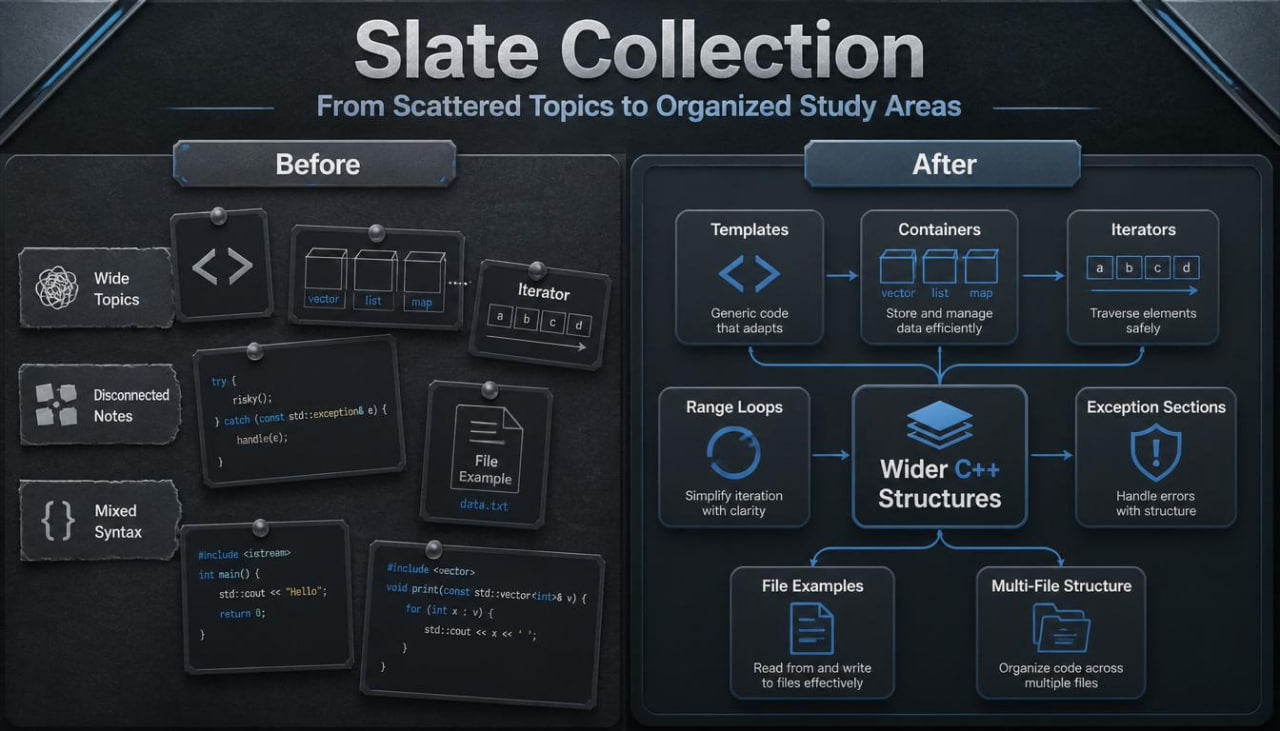
After learners study memory-related topics, they often meet C++ materials that combine several ideas inside one example. Templates may introduce unfamiliar angle-bracket syntax, containers may require new reading habits, and iterators can feel unusual because they move through data differently from a simple index. Exception handling can also feel separate from earlier topics when learners do not yet understand how a code path can respond to a problem during execution. File-based examples add another layer because data may move between written code and stored text. Slate Collection was created for learners who want a structured written course for these wider C++ topics without loud claims, rushed explanations, or pressure-based wording. -
Solution
Slate Collection arranges later-stage C++ topics into calm modules with annotated examples, comparison tables, glossary notes, and practice sections. The course begins with template reading, then moves into containers, iterators, exception handling, file stream basics, and multi-file structure. Each module connects the new topic with earlier Qelvanto ideas such as functions, classes, references, loops, arrays, and objects. Learners are guided to read unfamiliar syntax one part at a time, identify value movement, compare example styles, and describe code behavior in plain notes. The materials are written to support careful study, repeated review, and practical code observation. -
What’s Inside
Slate Collection begins with a course guide for studying wider C++ structures. The opening notes explain that later-stage C++ examples often contain several ideas at once: a function may use a template, a container may be passed by reference, an iterator may move through values, and an exception section may respond to an unexpected condition. Learners are encouraged to break each example into smaller reading zones: names, types, stored values, movement through data, and final behavior.
The first module introduces templates. Learners study how a template can describe a pattern that works with more than one type. The course begins with function templates because they are shorter and easier to observe than larger class templates. A small function is shown first with one type, then rewritten as a template. Learners compare both versions and identify which part becomes flexible. The notes explain angle brackets, type placeholders, function parameters, and return values in a steady order.
The next module focuses on class templates. Learners review a compact class example where a stored value can have different types depending on how the class is used. The course explains the class name, template line, placeholder type, member data, constructor, and member function. Practice tasks ask learners to identify where the placeholder appears and how a created object gives that placeholder a concrete type. This section connects template study with earlier Qelvanto work on classes and constructors.
Slate Collection then introduces containers. The course describes a container as a structure that holds multiple values in an organized form. Learners study common container behavior at a reading level: adding values, reading values, checking size, and moving through stored items. The examples stay compact and focus on understanding structure rather than memorizing many forms at once. Practice prompts ask learners to label the container name, stored type, inserted values, and loop behavior.
A module on sequence-style containers follows. Learners review examples where values are stored in order and visited one by one. The course compares index-based reading with iterator-based reading. The notes show how learners can follow a value from insertion to review, and how loop structure changes when a container is used instead of a fixed array. This section also includes short tasks where learners predict the order in which values are reviewed.
The iterator section is one of the central parts of Slate Collection. Learners study iterators as objects used to move through stored values. The course explains beginning position, ending position, movement, dereferencing, and comparison with the ending point. Each line is annotated so learners can see how the iterator travels through a container. The material also compares a loop with an index and a loop with an iterator, helping learners observe the difference in reading style.
Another section covers range-based loops. Learners review a shorter way to move through stored values while still understanding what happens behind the structure. The course explains the loop variable, the stored values, and whether the value is copied or referred to. Practice tasks ask learners to identify which variable represents the current item and how changing that variable may or may not affect the stored value.
Slate Collection also includes exception handling basics. This module explains how C++ can use structured response sections when a problem appears during program work. Learners study try, throw, and catch in short examples with plain explanations. The course shows how a code path can enter a protected section, send a problem value, and respond through a matching handler. The focus is on reading order and code behavior, not dramatic wording. Practice tasks ask learners to trace which line creates the problem value and which section responds to it.
A file stream basics module follows. Learners study how C++ examples can read from and write to files at a beginner-friendly review level. The course explains file objects, opening, writing, reading, checking state, and closing through compact examples. Learners are asked to identify where text is sent, where text is read, and how a condition can check whether the file operation is ready for use. This section avoids named outside programs and keeps attention on the C++ code itself.
The course also includes a module on multi-file organization. Learners study how declarations and implementations can be separated into related files in larger C++ study examples. The notes explain header-style declarations, source-style function bodies, include lines, and the reason names need to be introduced before use. Learners read a small example split into parts and answer questions about where a class is declared, where a function body appears, and how the pieces connect.
Slate Collection includes a combined workbook with templates, containers, iterators, exceptions, and file examples. Learners review short snippets, label syntax parts, trace stored values, compare loop styles, and explain exception flow. Some tasks ask learners to improve readability by renaming unclear variables, separating repeated logic, or writing a short note beside a complex line.
A glossary section explains template, placeholder type, class template, container, iterator, range-based loop, exception, throw, catch, file stream, declaration, implementation, and include line. Each term is paired with a compact C++ reference.
The final review set combines several topics from the tier. Learners read a compact C++ example using a template function, a container of stored values, a loop for review, a small exception section, and file-style output notes. Guided questions help learners trace the flow and describe each part in plain written language.
-
Who Is This For?
Slate Collection is for learners who already understand variables, functions, classes, arrays, strings, pointers, references, and object relationships. It is intended for learners who are ready to study later-stage C++ structures through written materials and careful examples.
This tier may fit learners who have seen templates or containers before but still find the syntax difficult to explain. It may also help learners who want more practice reading iterator loops, exception sections, file stream examples, and multi-file organization.
Slate Collection is suitable for learners who prefer structured modules, annotated examples, review notes, glossary pages, and practice tasks. The course focuses on code reading, topic connection, and steady C++ study without job claims, financial claims, or fixed outcome statements.
- What You’ll Learn
- How function templates are written and read
- How placeholder types appear in template examples
- How class templates connect with stored values and constructors
- How containers hold groups of values
- How sequence-style containers differ from fixed arrays
- How iterators move through stored data
- How dereferencing appears inside iterator examples
- How range-based loops review stored values
- How exception handling sections are arranged
- How file stream basics appear in small C++ examples
- How declarations and function bodies can be separated
- How to review wider C++ examples with written notes
-
Refund Note
Slate Collection is a paid Qelvanto tier. Eligible course purchases may be reviewed within a 30-day refund window according to the refund terms shown on the store page.
Self-paced learning overview
- 📘 Digital file available after purchase
- 🗂️ Long-term availability
- 🔐 Secure checkout
- 🗓️ Content updated in 2026
What format are Qelvanto courses provided in?
What format are Qelvanto courses provided in?
Qelvanto courses are provided as digital written materials with organized modules, examples, practice tasks, recap sections, and review notes. The focus is on reading, code observation, written exercises, and steady topic review.
Do I need previous C++ knowledge before starting?
Do I need previous C++ knowledge before starting?
Some Qelvanto tiers begin with beginner-friendly explanations, while wider tiers include more detailed C++ topics. Each course page explains the intended study stage, so learners can choose materials that match their current background.
Can I study at my own pace?
Can I study at my own pace?
Yes. The materials are arranged in sections, so learners can read, pause, return to earlier pages, and repeat practice tasks when needed.
Share