Qelvanto
Vertex Collection
Vertex Collection
Couldn't load pickup availability
-
Problem Statement
After studying many C++ topics separately, learners often need a course that brings those topics into connected examples. A learner may understand loops, functions, classes, and containers in separate sections, yet still feel unsure when they appear inside one longer file. Larger C++ examples require careful reading because values may move through functions, objects, references, containers, and file-related sections. Without a structured review path, it can become difficult to see where one topic ends and another begins. Vertex Collection was created for learners who want to study C++ through connected materials that gather earlier concepts into wider written practice. -
Solution
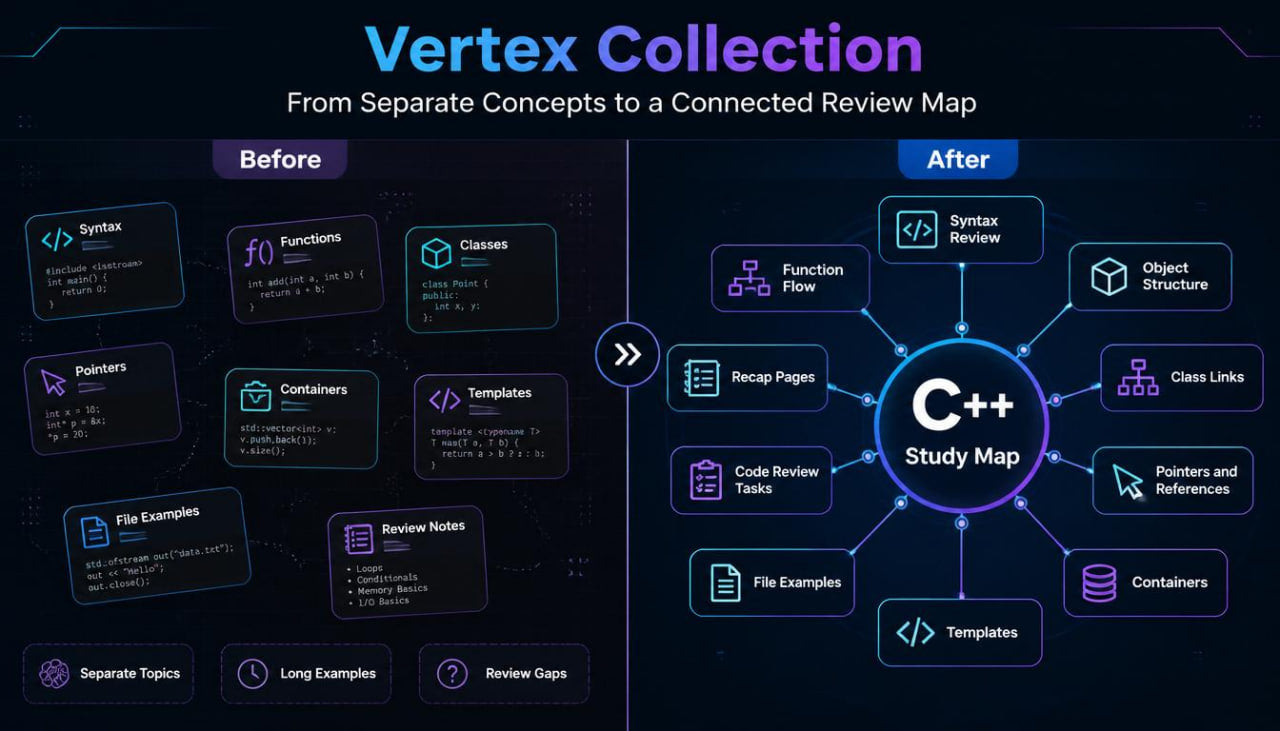
Vertex Collection gives learners a structured way to review and connect many C++ concepts inside one course. The materials are arranged around topic clusters, combined examples, code-reading notes, and workbook tasks that bring several ideas together. Each module begins with a focused explanation, then moves into examples that combine earlier Qelvanto topics in a readable order. Learners are guided to label sections, trace values, follow function calls, review class relationships, and explain code behavior in plain written notes. The course supports careful C++ study through organized pages, recap sections, and detailed practice prompts. -
What’s Inside
Vertex Collection begins with a course map that shows how the materials are arranged. The opening pages divide the course into connected study areas: syntax review, function flow, object-based structure, memory-related reading, containers, templates, file examples, and combined code review. This gives learners a clear way to move through the materials without treating the course as one large block.
The first module is a structured syntax review. Learners revisit statements, blocks, values, variables, conditions, loops, arrays, and strings. This section is not written as a beginner-only repeat. Instead, it helps learners review the core parts that still appear inside wider C++ examples. The module includes short code fragments with notes beside each line. Learners answer prompts about value changes, branch selection, loop order, and array positions.
The next module focuses on function flow. Learners study how function calls move reading from one section of code to another. The material reviews parameters, arguments, return values, declarations, helper functions, repeated logic, and function naming. Examples show how a larger file can become easier to study when related actions are placed into named functions. Practice tasks ask learners to follow values from the call line, into the parameter list, through the function body, and back to the calling section.
A dedicated object-based review follows. Learners revisit classes, objects, member data, member functions, constructors, public and private sections, setters, getters, and object state. The course shows compact class examples first, then moves into longer examples where objects are created, changed, compared, and passed into functions. Written tasks ask learners to label each class section, identify what the object stores, and describe how member functions change or return data.
Vertex Collection also includes a class relationship module. This section reviews composition, inheritance basics, derived class examples, member objects, constructor chains, and simple relationship maps. Learners study how one class may contain another object, how related classes may share structure, and how object values move across class boundaries. The module uses text-based maps and annotated code rather than relying on outside diagram tools. Practice prompts ask learners to identify the relationship type, trace constructor values, and explain which object owns each stored value.
The memory-related module brings together pointers, references, address reading, dereferencing, reference parameters, pointer parameters, null pointer checks, array-pointer examples, and dynamic allocation basics. The course repeats a careful reading routine: identify the original variable, find the address or reference, follow the symbol, then describe the change. Examples are written to keep each memory-related step visible. Learners complete tables that separate names, values, addresses, pointer targets, and final results.
Another section focuses on containers and iterators. Learners review stored groups of values, adding items, reading items, checking size, iterator movement, range-based loops, and value references inside loop structures. The module compares fixed arrays with container-based examples, then shows how iterators move through stored values. Practice tasks ask learners to mark the start position, ending position, current item, and value used during each loop pass.
Templates receive their own module inside Vertex Collection. Learners revisit function templates and class templates through examples that use placeholder types, parameters, return values, stored data, and object creation. The course explains how template syntax can be read part by part. Learners compare a type-specific function with a template version and explain what changes in the structure. Class template examples connect this topic with earlier work on constructors and member functions.
The course also includes exception handling and file example sections. The exception handling module reviews try, throw, and catch through short examples that show how a code path responds to a selected issue during program work. The file example module introduces reading and writing through file-style objects, checking whether a file section is ready for use, and closing file work when the example is complete. These sections are written at a reading and review level, so learners can understand the structure without being pushed into large outside setups.
A multi-file organization module helps learners review how C++ study examples can be separated into related parts. Learners study declaration areas, implementation areas, include lines, class declarations, and function bodies. The materials explain how names are introduced and then used across connected sections. The examples remain compact, but they give learners a useful view of how larger C++ materials can be arranged.
Vertex Collection includes a combined workbook with detailed review tasks. The workbook contains several connected C++ examples. One task may include classes and containers. Another may include references, functions, and arrays. Another may include templates and object creation. Learners are asked to label sections, complete missing lines, trace values, explain branches, compare code versions, and write short review notes.
A code review section focuses on readability. Learners examine snippets with unclear names, crowded logic, repeated sections, missing comments, or confusing order. The goal is not to rewrite everything, but to observe what makes code harder to follow and how small structural choices can improve study readability. Learners write notes about naming, spacing, function separation, and section order.
The course also includes recap pages after each major topic cluster. These pages gather key ideas into short explanations, small code references, and review prompts. A glossary covers terms from across the full course line, including statement, variable, condition, loop, array, string, function, parameter, return value, class, object, constructor, composition, inheritance, pointer, reference, template, container, iterator, exception, file stream, declaration, and implementation.
The final review section brings many topics together in a longer guided example. Learners read a compact C++ file that includes functions, objects, a container, references, a template-style section, and a file-related note. The review questions guide learners through the code in order: identify the data, find the functions, read the class, trace the object, review the container, follow value changes, and explain the final behavior.
-
Who Is This For?
Vertex Collection is for learners who have already studied several C++ topics and want a broader course that connects them. It is suitable for learners who understand separate ideas such as functions, classes, pointers, and containers, but want more practice reading them together.
This tier may fit learners who want a detailed written review before moving into their own larger practice files. It is also useful for learners who want recap pages, combined examples, glossary notes, and workbook-style tasks in one place.
Vertex Collection is written for learners who prefer structured digital materials, annotated examples, and practical study exercises. It does not include job claims, financial claims, or fixed outcome statements. The focus is on C++ reading, topic connection, code organization, and steady practice.
- What You’ll Learn
- How to review C++ syntax across connected examples
- How function calls move values through a file
- How parameters, arguments, and return values connect
- How classes, objects, and member functions work together
- How constructors place starting data into objects
- How class relationships appear in composed and derived examples
- How pointers and references change value flow
- How containers organize stored groups of values
- How iterators move through stored data
- How templates appear in functions and classes
- How exception handling sections are arranged
- How file examples are written and reviewed
- How declarations and implementations can be separated
- How to read larger C++ examples through smaller study zones
- How to write plain review notes about code behavior
-
Refund Note
Vertex Collection is a paid Qelvanto tier. Eligible course purchases may be reviewed within a 30-day refund window according to the refund terms shown on the store page.
Self-paced learning overview
- 📘 Digital file available after purchase
- 🗂️ Long-term availability
- 🔐 Secure checkout
- 🗓️ Content updated in 2026
What format are Qelvanto courses provided in?
What format are Qelvanto courses provided in?
Qelvanto courses are provided as digital written materials with organized modules, examples, practice tasks, recap sections, and review notes. The focus is on reading, code observation, written exercises, and steady topic review.
Do I need previous C++ knowledge before starting?
Do I need previous C++ knowledge before starting?
Some Qelvanto tiers begin with beginner-friendly explanations, while wider tiers include more detailed C++ topics. Each course page explains the intended study stage, so learners can choose materials that match their current background.
Can I study at my own pace?
Can I study at my own pace?
Yes. The materials are arranged in sections, so learners can read, pause, return to earlier pages, and repeat practice tasks when needed.
Share